
Is Charleston SC Growing Faster Than Its Roads?
Is Charleston's Growth Outpacing Its Roads?
In the fastest-growing pockets of the Tri-County, yes, at least for now. Berkeley County added roughly 44,800 residents between 2020 and 2025, a 19.5% jump, according to the U.S. Census Bureau. In that same window, Charleston County defunded its largest planned road project, and the road serving one of the region's biggest new communities isn't scheduled for widening until the early 2030s. At the same time, actual housing inventory across all three counties has been loosening all year, giving buyers more real choices than the growth headlines alone would suggest. Here's what the real numbers show, county by county and project by project.
How Fast Is the Tri-County Actually Growing?
South Carolina added nearly 80,000 residents between July 2024 and July 2025, and the coast is one of four regions in the state where that growth is showing up as real, measurable congestion, according to SCDOT Secretary Justin Powell. Powell has compared parts of the Charleston area's traffic volume to the stretch of I-85 between Greenville and Spartanburg, a corridor known statewide for its backups.
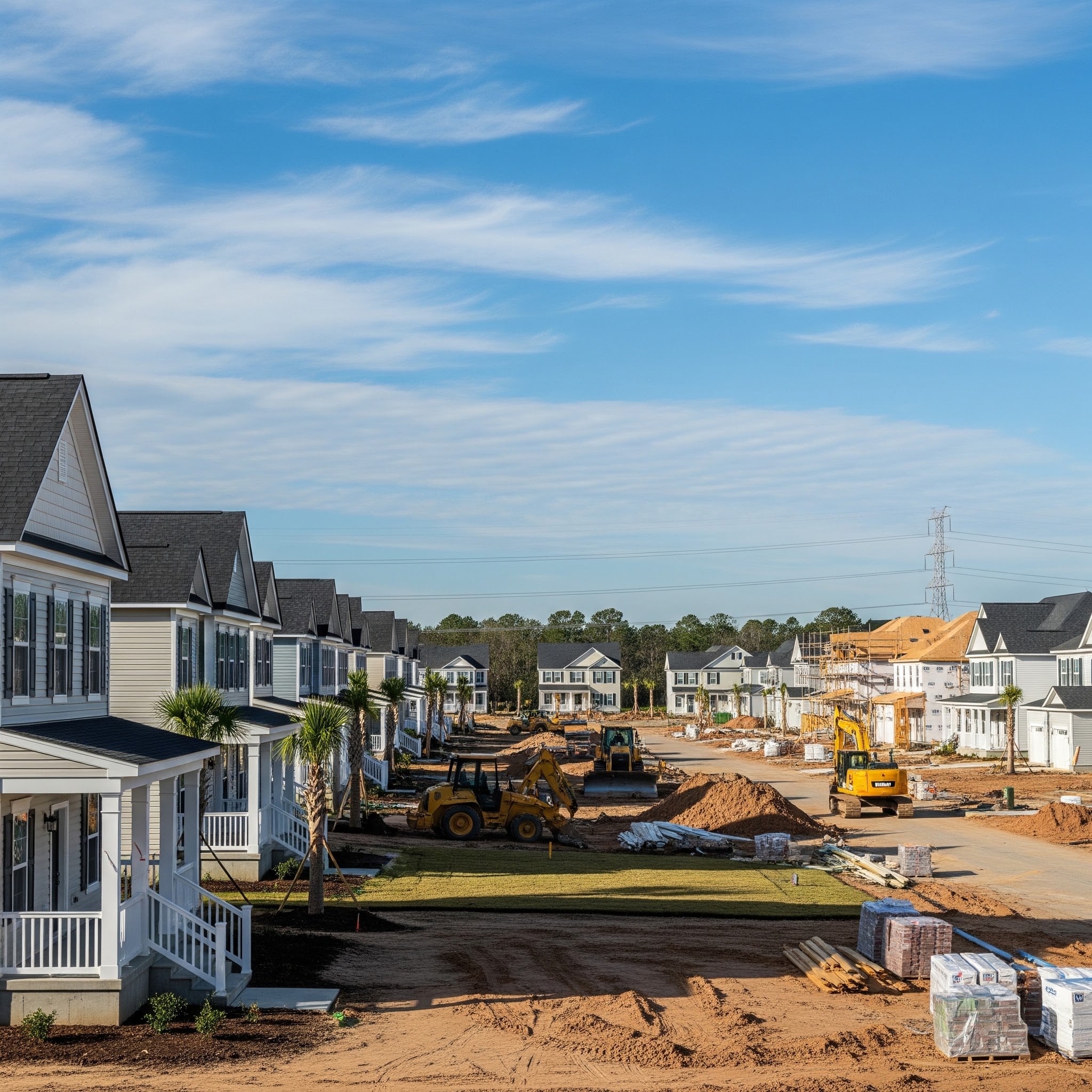
The growth is not evenly spread. Berkeley County is the clearest example: Cane Bay Plantation now has more than 13,000 residents, Nexton has passed 10,000, and Carnes Crossroads has topped 3,800, a combined gain of roughly 27,000 people since 2015 across those three communities alone, per Post and Courier reporting. Nexton itself is on pace to house 10,500 homes by 2032, split between roughly 7,500 for-sale properties and 3,000 rentals, with about 4,100 already sold as of this year. Brookfield Properties, the developer behind Nexton, has said the surrounding cluster of communities could reach 50,000 to 75,000 residents within the next decade.
That kind of growth puts real pressure on roads that were built for a much smaller population. Berkeley County Supervisor Johnny Cribb put it plainly when discussing a recent federal grant: the goal now is "keeping up with rapid growth," not getting ahead of it.
The Road Projects Trying to Catch Up
Not every infrastructure story in the Tri-County is a delay. Some major projects are funded and under construction right now, while others are genuinely years out. Here's where the real money and real timelines stand as of this summer.
| Project | Cost | Status |
|---|---|---|
| I-526 Mark Clark Extension | $420 million | Defunded January 2026, reallocated to 9 other projects |
| Main Road & Savannah Highway Interchange (West Ashley to Johns Island) | Reported between $364 million and $445 million | Under construction, targeted for fall 2028 |
| SC-41 widening, Highway 17 to Clements Ferry Road (Mount Pleasant) | $245 million | Construction starting in 2026 |
| US-176 widening, Phase 2 (Nexton Parkway to Jedburg Road) | $22.5 million federal grant secured | In design and permitting, no construction date set |
| I-26 widening, mile markers 172 to 187 (Berkeley and Dorchester) | Not yet disclosed | Public comment closed May 2026, construction not yet scheduled |
| Nexton Parkway widening (Berkeley County) | $4.7 million budgeted for design and permitting in 2027 | Construction not expected before 2029, pending a 2028 bond referendum |
A word on that Main Road and Savannah Highway number: reports this year have put the total cost anywhere from $364 million to $445 million, depending on the source and when it was published. Charleston-area infrastructure costs have run roughly 70% higher than pre-2020 estimates industry-wide, per Charleston County Public Works Director Eric Adams, so treat any single figure on a multi-year project as a moving target rather than a locked-in number.
What's actually moving right now
The Palmetto Commerce Interchange, connecting Weber Boulevard to I-26 near the airport, finished ahead of schedule. James Island's Fort Johnson and Secessionville Road improvements are under construction. The Airport Connector Road began right-of-way acquisition in 2025 with construction targeted for later this year. These are real, funded, in-progress projects, not just line items on a wish list.
What's still years away
The projects with the longest runway are concentrated in the fastest-growing parts of Berkeley County. Nexton Parkway widening won't break ground before 2029 at the earliest, and Brookfield Properties' William Fishburne noted that 75% of the parkway's traffic today is people passing through, not local residents, which is a real strain on a road that was originally built as two lanes. US Highway 78 near Ladson isn't scheduled to start construction until early 2028.
What This Means for Housing Inventory Right Now
Here's the part of this story that doesn't get much coverage: while roads catch up on their own timeline, housing supply has already loosened this year. We pulled active listing and months-of-inventory data directly from Charleston Trident MLS for all three counties, comparing January 2026 to July 2026.
| County | Active Listings, Jan 2026 | Active Listings, Jul 2026 | Change | Months of Inventory, Jul 2026 |
|---|---|---|---|---|
| Charleston County | 1,965 | 2,295 | +16.8% | 3.59 |
| Berkeley County | 1,349 | 1,649 | +22.2% | 3.48 |
| Dorchester County | 864 | 1,039 | +20.3% | 3.54 |
Source: Charleston Trident MLS, pulled live via the residential property type, which blends single-family, attached, and condo sales and both resale and new construction together, since this MLS does not report those categories separately in its statistics tool. Berkeley County's 22.2% jump in active listings is the largest of the three, which lines up with how much new construction is actually closing in Nexton, Cane Bay, and Carnes Crossroads.
A months-of-inventory reading in the mid-3s is still balanced-market territory, not a flood of unsold homes. But it's a real, measurable loosening from where the market sat in January, and it's worth remembering alongside the growth numbers from earlier in this piece. Those 44,800 new Berkeley County residents needed somewhere to live, and a meaningful share of this year's new listings are the homes built to house them, not existing owners suddenly deciding to sell.
If you're wondering whether this loosening means it's suddenly a buyer's market across the board, it isn't automatic. We covered this exact question in our recent breakdown of Charleston's new housing fund and in our look at investor activity in Berkeley County: more inventory gives buyers more room to negotiate, but well-priced homes in strong locations are still moving close to full price. More choices is not the same thing as a soft market.
What This Means If You're Buying in a Growth Corridor
If you're looking at Mount Pleasant, Hanahan, Goose Creek, or anywhere in the Nexton and Cane Bay corridor, the honest answer is that growth here is real, funding is uneven, and neither fact should be the whole decision by itself. A community sitting on a funded, in-progress project, like the SC-41 widening near Mount Pleasant, is a different bet than one waiting on a bond referendum that hasn't happened yet.
This is the same trade-off we mapped out block by block in our real commute-time breakdown of all 10 Tri-County suburbs, and it's worth reading alongside this piece if drive time and road timing are part of your decision. The suburbs with the longest current commutes are largely the same ones carrying the longest wait for their next road upgrade, which isn't a coincidence.
None of this means avoid the growth corridors. It means go in with real numbers instead of a headline. That's exactly the kind of local detail I walk buyers through before they write an offer, because the difference between a road project that's funded and one that's still five years from a ballot measure is the kind of thing that's easy to miss until you're the one commuting through it every day.
Charleston's growth is real, the roads are catching up unevenly, and inventory has genuinely loosened across all three counties this year. Those three things together change the calculus on where and when to buy, and the right read depends on the specific corridor you're looking at.
I work with buyers across the whole Tri-County, including the growth corridors covered here, and I can walk you through which nearby infrastructure projects are actually funded versus still years out before you commit to a neighborhood. Start browsing with real listings matched to what matters to you here: VIP Home Search. If you'd rather just talk it through first, grab a time with me here: book a discovery call.
Frequently Asked Questions
Is Charleston SC growing too fast for its infrastructure?
In the short term, yes, in specific corridors. Berkeley County grew 19.5% between 2020 and 2025, and several major road projects, including the Nexton Parkway widening, are not expected to be finished until the early 2030s. Other projects, like the SC-41 widening in Mount Pleasant and the US-176 improvements in Berkeley County, are funded and moving now, so the gap is real but uneven across the Tri-County rather than uniform everywhere.
What happened to the I-526 Mark Clark Extension?
Charleston County Council voted in January 2026 to defund the $420 million Mark Clark Extension after years of resident opposition and rising construction costs. The county redirected that funding into nine other projects, including improvements to Dorchester Road, Maybank Highway, and the Main Road corridor.
Is Nexton still a good place to buy with the parkway widening delayed?
That depends on your priorities and timeline, not just the road schedule. Nexton is expected to grow toward 10,500 homes by 2032, and its parkway is heavily used by through traffic from outside the community, so the widening delay is worth factoring into your decision. It is not, by itself, a reason to rule the area out, since Berkeley County has already secured funding to widen the connecting stretch of US-176.
Is housing inventory increasing in Charleston, Berkeley, and Dorchester counties?
Yes. Charleston Trident MLS data shows active listings rose in all three counties from January to July 2026, with Berkeley County seeing the largest increase at 22.2%. Months of inventory in July 2026 ranged from 3.48 in Berkeley County to 3.59 in Charleston County, both still inside balanced-market territory rather than a buyer's market.
Should road projects and growth affect where I buy in the Tri-County?
They are worth weighing alongside price, schools, and commute, not the only factor. A growth corridor with a funded road project moving now is a different bet than one waiting on a 2028 bond referendum, and knowing which is which before you write an offer is exactly the kind of local detail a market analysis should cover.
About Brett Kelley
Brett Kelley is the team leader of The TREAT Team in Charleston, SC. Leading a team of experienced advisors, Brett has personally closed more than 300 homes and helps buyers, sellers, and investors across the Charleston, Berkeley, and Dorchester County tri-county area with an honest, client-first approach.
SCSOLD, LLC · 843.738.2394
Equal Housing Opportunity. Brett Kelley, The TREAT Team, SCSOLD, LLC. South Carolina Real Estate Commission License #96167. This article is general information only and is not legal, tax, or financial advice. Road project costs, timelines, and funding status change as county and state budgets are finalized, so confirm current status directly with SCDOT or your county's public works department before making a decision based on any single project date in this article.