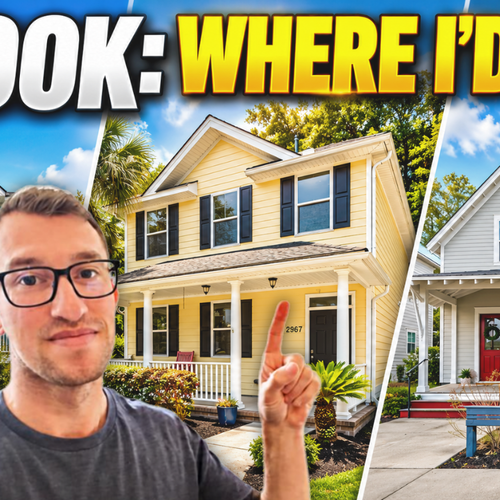

Buying New Construction in Charleston SC: What to Know Before You Visit a Model Home
What Should You Know Before Buying New Construction in Charleston SC?
Compare the whole builder package, not just the rate. Get your own agent registered before your first model home visit. Pick the community and the lot with a plan. Spend on structure, not finishes. Have the home inspected before the drywall goes up. And if you are moving here from out of state, apply for the South Carolina 4 percent legal residence assessment, because it is not automatic and missing it costs real money.
I'm Brett Kelley, team leader of The TREAT Team at SCSOLD, LLC. Not long ago, an inspector found trash, old food, and a cup someone had used as a bathroom inside the walls of a client's brand new home, right before the drywall went up. I'll tell you how we caught it below. First, the good news: you are probably not priced out of Charleston. You may just be shopping in the wrong half of the market. In what I am seeing right now, about two out of three builders are offering some kind of incentive. You just need to know how to read them. If you would rather watch, the full video is right here.
This guide covers new construction across Charleston, Berkeley, and Dorchester Counties. Builder incentives change often and vary by builder, so use this as a map, not a quote.
Builder Incentives and Rate Buydowns: Read the Strings
Builder incentives usually show up as help with closing costs, money toward upgrades, a price cut, or a lower rate. They almost always come with strings. Usually that means the builder's preferred lender is involved. Sometimes it is also their closing attorney, title company, or insurance agent. The builder may own a piece of some of those, if not all of them. That is not automatically bad. Just know what you are trading for the incentive.
Two definitions matter here.
- Temporary buydown. It lowers your rate for the first year, sometimes two years, and then it steps back up.
- Permanent buydown. It buys the rate down for the entire life of the loan.
Those are not the same thing, and over time the difference can be thousands of dollars.
Here is a real one. This week, a builder in Ladson sent me an offer with a fixed rate well below the national average. That is a great deal. But the low monthly payment they advertised was based on a different loan, an adjustable rate that can change after five years. That is called a 5/1 ARM. So compare the whole package: price, rate, closing costs, and every vendor you are agreeing to use. Get a loan estimate from the builder's lender and put it side by side with one from an outside lender. Literally side by side. Look at the fee sheets.
This works on resale homes too. Seller credits can buy down your rate. Same tool, different seller. You can run your own numbers on our mortgage calculator.
Register Your Agent Before You Walk Into the Model Home
The person in the model home is great at their job. Their job is representing the builder. That is not a knock on anyone. It just means they work for the builder and not for you.
You can always have your own agent. But many builders have a registration policy: your agent has to be with you or registered at your very first visit. Walk in alone first and the builder may not pay your agent. Then you would either pay for your own representation or go without it. Check the builder's policy before you go. It takes two minutes.
The builder's contract is also written by the builder's attorney to protect the builder. Deposits may be non-refundable. Completion dates can move. It has happened to me. You want someone reading it who works for you and who understands what can happen over the whole process.
If you want help before you ever visit a model, tell us four quick things: the type of home you want, where you are looking, your price range, and your timeline. Then we will hop on a call, walk you through a short list of Tri-County communities that fit, and show you which builders have the strongest incentives right now. Our new construction page also has a live search across all three counties.
Picking a Community: Needs, Location, and Lot
Say you have your short list. How do you choose? Start with your needs.
- What monthly payment are you actually comfortable with? Not just what the lender approves you for.
- Where is your commute? Where are you coming from, and where are you going?
- How many bedrooms do you need today, and in five years?
Model homes are built to make you fall in love, and every single one is loaded with top-of-the-line upgrades. Walk in without a plan and the model sets your budget for you. Walk in with a plan and you set it.
Then location. It is bigger than a mailing address. Two homes with a Summerville address can sit in two different counties, with different school districts and different tax bills. Start with the map, not the floor plan. Our Summerville area guide shows how that plays out.
Then the lot. Builders charge premiums for pond views, a wooded backyard, a corner lot, and a cul-de-sac. Sometimes the premium is worth every dollar, because the lot is the one thing you cannot change later. It matters at resale too. And here in the Lowcountry, ask about drainage and flood zones, because flood insurance can change your monthly payment. Read our Charleston flood zones explained guide before you fall for a lot.
Spec Home or To-Be-Built?
A spec home is one a builder has already started without a buyer, so it is finished or very close to it. The finishes are already picked. You usually get a faster closing and often the strongest incentives, because every month it sits costs the builder money.
A to-be-built home is yours from the ground up. You pick the plan, the lot, and the finishes. The trade-off is time, often several months or more. That also raises a question about when to lock your rate. That is a strategy call to make with a lender, not a guess.
The short version: a spec home gives you leverage. A to-be-built home gives you choices.
The Design Center: Spend on Structure
If you build, you get the part most buyers love, the design center meeting. Colors, tile, flooring, cabinets, door handles, even the pendant lights over the island. It is a lot of fun. It is also where a budget can climb much faster than buyers expect.
Our rule: spend on structure, be careful with finishes. An extra bedroom or a covered porch is expensive, or nearly impossible, to add later. Paint and light fixtures can be changed down the road, often for a lot less. You can swap a light fixture on a Saturday. You cannot add a porch on a Saturday.
Walk-In Shower or Garden Tub?
It is the question we get most about the primary bathroom. Do you want a walk-in shower, or a smaller shower with room for a garden tub? It depends on how you live. If you go shower only, keep a tub somewhere else in the house, because it helps at resale. Decide early. This is often a structural option, not a finish.
What Is Behind the Walls: Framing, Foundations, and Insulation
Two homes with the same square footage can be built very differently. That shows up in your power bill and your maintenance for as long as you own the house.
- Framing. Exterior walls are usually framed with 2x4s or 2x6s. A 2x6 wall is deeper, which leaves more room for insulation. Ask which one you are getting.
- Foundation. Around here you will see three main types: a slab, which sits right on the ground; a crawl space, which lifts the house with open space underneath; and a raised home, which sits higher. In our humidity, how a crawl space is sealed and ventilated really matters. Raised homes show up more in flood-prone areas, which can affect your flood insurance. Our cost of living breakdown covers what insurance does to a monthly payment.
- Insulation. Ask what kind is in the walls and in the attic.
You do not need to be a builder to do any of this. You just need to ask before you sign.
Third-Party Inspections and Warranties
Yes, you should inspect a brand new home. The county inspects for code, and code is the minimum. The builder's project manager walks the home too. But a third-party inspector works for you.
Remember the cup from the top of this article? One client's home was at pre-drywall, which means nothing was covering the plumbing or the electrical yet. We had a pre-drywall inspection done, and we almost got to it too late. The stairs were already partly covered up. But in the area that was not closed in yet, the inspector spotted debris. We looked closer, and in the spaces that were about to be hidden were trash, old food, and a cup someone had used as a bathroom. I am not making this up. If that had been sealed behind drywall, who knows what that family would have been living with.
Here is the rhythm I recommend:
- Pre-drywall inspection, while every wire, pipe, and duct is still visible.
- Final inspection, when the house is nearly done, before your blue tape walkthrough. That is when you go through peeling blue tape onto paint nicks and little imperfections. Everything you find lands on a punch list. It is a fun moment.
- One more inspection around month 11, before the first-year warranty runs out.
Builder Warranties
A common warranty setup is one year on workmanship, two years on major systems, and ten years on structure. But every builder's warranty is a little different, so read yours line by line. Find a problem in month 11 and the builder typically fixes it. Find it in month 13 and it is usually on you.
The South Carolina 4 Percent Legal Residence Assessment
This is the form I mentioned at the start, and most people moving here miss it. In South Carolina, there is a difference between your primary residence and a second home. Your primary residence can be assessed at 4 percent instead of 6 percent. It is also exempt from school operating taxes. But it is not automatic. You have to apply with the county where you bought.
If you miss it, you pay the higher rate. Over several years, that adds up fast. In some cases you can get a refund, but once you are past the allowed window, it is on you. If you are moving here from out of state, write this one down.
Where to apply, based on each county's own pages:
- Charleston County. The page says the deadline to file is typically January 15 each year.
- Berkeley County. Applications are online, and you register for an account to start. The county's recent notices list January 15 as the deadline for new owners.
- Dorchester County. Wait until your deed is recorded before you apply. The address must match your driver's license and vehicle registrations.
Rules and deadlines can change, so confirm with your county assessor before you file.
What Doing It Right Looks Like
- You compared the full deal, not just the rate.
- Your agent was registered before your first visit.
- You picked a lot you will still love in 10 years.
- You put your money into the bones of the house.
- You had it inspected before the drywall went up.
On move-in day, you are not wondering what you missed. You are not out of the market. You just need a better map.
Frequently Asked Questions
Do I need my own agent to buy new construction in Charleston SC?
You can always have your own agent, and I recommend it, because the person in the model home works for the builder. Many builders have a registration policy that says your agent has to be with you or registered at your very first visit. If you walk in alone first, the builder may not pay your agent, and you would either pay for your own representation or go without it. Check the builder's policy before you go.
What strings come with builder incentives?
Builder incentives usually show up as help with closing costs, money toward upgrades, a price cut, or a lower rate. They almost always come with strings. Usually that means the builder's preferred lender is involved, and sometimes the builder's closing attorney, title company, or insurance agent too. That is not automatically bad. Just know what you are trading for the incentive, and compare the whole package, including price, rate, closing costs, and every vendor you agree to use.
What is the difference between a temporary and a permanent rate buydown?
A temporary buydown lowers your rate for the first year, sometimes two years, and then it steps back up. A permanent buydown lowers the rate for the entire life of the loan. Over time, the difference can be thousands of dollars. Always check which loan the advertised monthly payment is based on, because an adjustable rate loan such as a 5/1 ARM can change after five years.
Should I choose a spec home or a to-be-built home?
A spec home is one a builder started without a buyer, so the finishes are already picked, closing is usually faster, and the incentives are often the strongest because every month it sits costs the builder money. A to-be-built home lets you choose the plan, the lot, and the finishes, but it takes several months or more. A spec home gives you leverage. A to-be-built home gives you choices.
Do I need an inspection on a brand new home?
Yes, I would get one. The county inspects for code, and code is the minimum. The builder's project manager also walks the home, but a third-party inspector works for you. I recommend a pre-drywall inspection while the wires, pipes, and ducts are still visible, a final inspection before your blue tape walkthrough, and one more around month 11, before the first-year warranty runs out. Warranty terms vary by builder, so read yours line by line.
What is the South Carolina 4 percent legal residence assessment?
In South Carolina, your primary residence can be assessed at 4 percent instead of 6 percent, and it is also exempt from school operating taxes. It is not automatic. You have to apply with the county where you bought. Charleston County says the deadline is typically January 15 each year. Dorchester County asks you to wait until your deed is recorded, and the address has to match your driver's license and vehicle registrations. Berkeley County requires an online account to apply. Confirm current rules with your county assessor.
If you are thinking about new construction anywhere in Charleston, Berkeley, or Dorchester County, build your short list here. Tell us the type of home, where you are looking, your price range, and your timeline. We will match you with communities that fit and with the incentives available today. You can also call or text 843.738.2394, or grab a time with me for a free consultation. If new construction is not the right move for your situation, I will tell you that too.
Moving from out of state? Our free Charleston relocation guide covers neighborhoods, schools, cost of living, and the home-buying process.
About Brett Kelley
Brett Kelley is the team leader of The TREAT Team in Charleston, SC. Leading a team of experienced advisors, Brett has personally closed more than 300 homes and helps buyers, sellers, and investors across the Charleston, Berkeley, and Dorchester County tri-county area with an honest, client-first approach.
SCSOLD, LLC · 843.738.2394
Equal Housing Opportunity. Brett Kelley, The TREAT Team, SCSOLD, LLC. South Carolina Real Estate Commission License 96167. This article is general information only and is not legal, tax, or financial advice. Builder incentives, rates, tax rules, and deadlines change often and vary by builder and by county, so confirm details with a licensed lender, your county assessor, and your closing attorney before you decide.